The Case for Change
Dear reader,
My campaign is focused on providing long-term solutions to a variety of problems Kingston faces. Socially, Kingston is facing prolonged issues with public homelessness and substance abuse, which in turn is having an impact on local health and safety. Economically, Kingston is feeling the stresses of affordability both by individual citizens and the City's own financial health. Global events beyond our control are causing price increases in every aspect of our life and for many the strain is becoming unbearable.
The 2019 edition of Kingston's 10-Year Municipal Housing and Homelessness Plan outlined a bleak picture. Hundreds of homeless individuals, and thousands of households spending over the benchmark 30% of household income on housing. In response to this, the report set a target to construct only 120 additional affordable units over the next five years. It is hard to refer to this as a band-aid solution, because at these numbers 120 units has had no noticable impact on the living situation in Kingston.
We are now in a mid-cycle review of the 10-Year MHH Plan and the picture is even worse. The number of homeless individuals has almost tripled to 572 people, as tracked by the city's own By-Name list, but local organisations like Threads of Hope estimate the population could be closer to 1000 when including unregistered individuals. It suffices to say that the reaction of both the private sector and our municipal government have failed to step up to the plate and deal with these problems.
As a result of the pressures of affordability more people are being driven to homelessness, crime, and substance abuse. To those of us who spend time out in the community these symptoms are becoming ever more apparent.
Two things are clear to me when thinking of solutions:
One, we need good public services in order to deal with these problems. Emergency services, hospitals, schools and daycares, community centres, parks… I won't bore you but the list goes on and on.
Two, we need money to pay for these good public services. Traditionally these are paid by everybody through taxes, but increasing taxes to pay for these services is out of the question right now. As mentioned, we are facing an affordability crisis. The answer cannot lie in making things even less affordable for Kingstonians.
So how do we pay for things without taxation?
For Kingston specifically, the opportunity to do this exists through entering the market as a large-scale residential landlord. It might sound radical and impossible, but it's already being done. The Kingston owned Kingston & Frontenac Housing Corporation provides 1,600 units to residents Kingston and Frontenac County while maintaining a small operating surplus. It remains to be seen what the 2026 MHH Plan outlines for affordable unit expansion, but the only solution is to make every effort possible to double the size of the Kingston and Frontenac Housing Corporation over the next 10-years. This seems like an impossible feat, but federal CMHC funding can cover up to 95% of construction costs through long-term preferred rate loans. This means for a small amount of seed capital provided through the city, the KFHC could stretch that investment 20-fold through CMHC loans.
On top of expanding the KFHC, Kingston should seek to create a new housing corporation to develop high-quality residential units and endeavour to rent them out below current market rates, while still maintaining surpluses. By managing affordable rates, energy efficiency and environmentally forward design, and accessibility the City is able to unlock most of the funding for such development through CMHC's Apartment Construction Loan Program (ACLP), which provides long-term low-rate financing specifically for purpose-built rental housing. Kingston also has considerable borrowing capacity, financially enabling a plan like this without incurring additional costs for taxpayers.
Private developers have been profiting off of apartment rentals in Kingston for far too long, it's time we invest in ourselves and reap the benefits.
It's almost unbelievable to think about all of the positive side-effects that a structured, large-scale development like this could bring about for our community. For just one example, equipment standardization can create economies of scale in the region. Ordering large quanities of the same products can reduce the costs of items like HVAC, lighting, and solar installations. On top of lowering long-term development costs for Kingston this also spills over into the local economy. The next time you need to replace a furnace, or if you want to install solar panels, it could be cheaper simply as a side effect of good economic policy.
The combined efforts of the KFHC to reduce the pressure of housing costs on our most vulnerable residents, and the profits from this currently unnamed "Second Housing Corporation", will position Kingston to be able to eliminate homelessness by providing us with the institutional infrastructure and investment needed to deal with this public health epidemic.
Enough of the dreaming, though. How do we get there?
Cataraqui Bay
A flagship development for a generation.
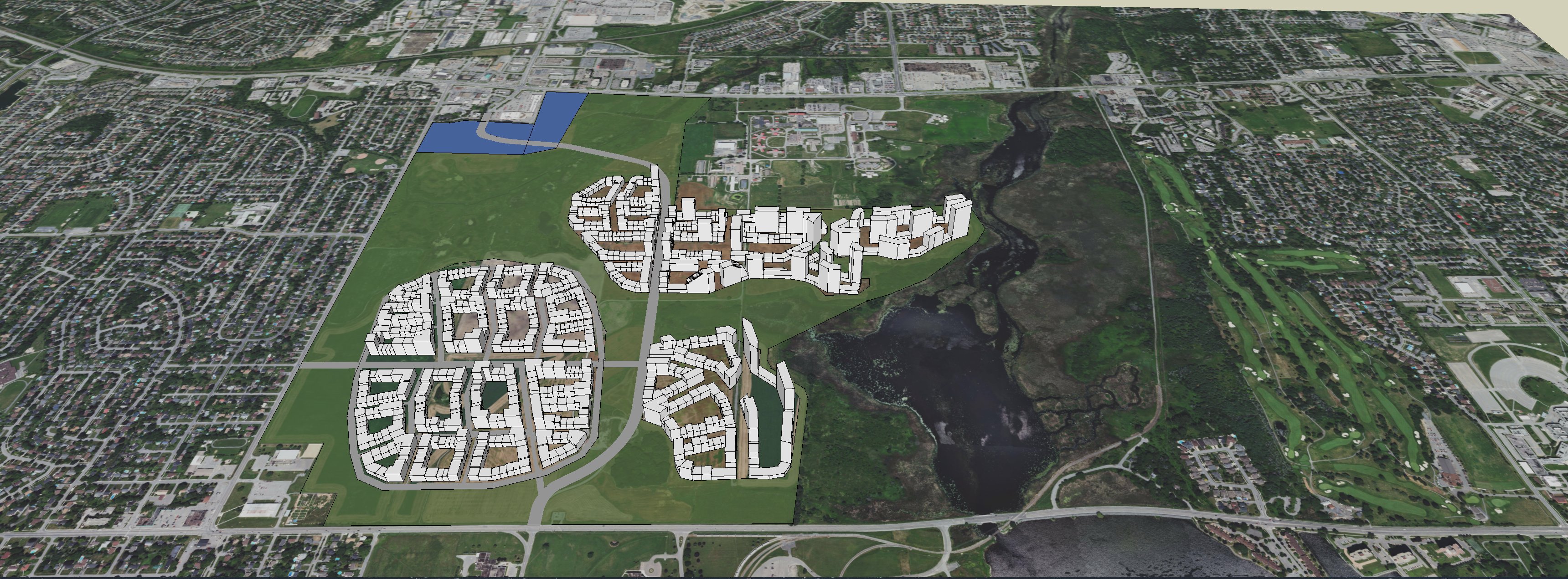
There is a lot of land available throughout the city that is suitable to develop and get us started, but the most appropriate area is the Collins Bay Penitentiary farmland. An area that I like to refer to as Cataraqui Bay. Clean fields clear of obstructions, ideally located near major utility hubs for fresh water, wastewater, and electrical. Central to Kingston with good access to primary transport arteries such as Gardiner's Road, Day's Road, Bath Road, and Front Road/King Street.
I will lobby the Government of Canada and the Correctional Service of Canada to release these lands in our public interest to develop a city-scale master planned community. While the housing plan would not be restricted to these lands, they would be the flagship long-term goal of the City.
My Commitments
What I promise to provide.
My platform runs on practical ideas and long term thinking. I commit to seeking the opinion of experts in planning, architecture, the environment, and more in order to execute this plan correctly and precisely.
The projects I’m proposing are decade-spanning endeavours. I commit not to yield to shortcuts, ensuring that the city delivers these projects as high quality long-term assets and at no added cost to taxpayers.
The city is obligated to provide first-class services in every aspect of its operations, and Kingstonians have every right to know how that’s being done. I commit to running on a platform of transparency and accountability.